How much does moving from the USA to Poland cost?

There is no honest one-number answer to "how much does moving from the USA to Poland cost." The price depends on how many cubic meters you ship, which port your goods leave from, the season, and how much of the work you outsource — from ocean freight alone to full door-to-door service with packing. Rather than hunting for a price range, it pays to understand what the bill is made of and request a quote built around your actual shipment.
This guide walks through what really drives the price, when a full container beats shared freight, and how the duty and VAT exemption for household goods (mienie przesiedleńcze) works — often the single biggest saving when relocating to Poland. As a licensed freight forwarder operating since 1994, with our own New Jersey warehouse and an office in Poland, we deliver a fixed, individual quote within 24 hours.
1. What makes up the cost of a move from the USA?
A transatlantic moving bill is always a sum of parts, never one flat rate. The largest line is ocean freight: with shared-container shipping (LCL) you pay for the space you actually use, while a full container (FCL) comes at a single container rate. Around that core sit optional services on both the American and Polish side that you can add or skip.
Season matters too — carrier rates tend to climb during peak moving months — as does the pickup distance from your home to our warehouse at 918 Clinton Ave in Irvington, New Jersey. The export paperwork — Bill of Lading, ISF, the AES/EEI filing, commercial invoice, and packing list — is something we prepare for every client as part of the service.
- Ocean freight: LCL (pay per space used) or FCL (whole container)
- US pickup — cost grows with distance from our New Jersey warehouse
- Packing services and materials (optional — you can pack yourself)
- Export documents: B/L, ISF, AES/EEI, invoice, packing list
- Customs clearance and delivery to your address in Poland
- Shipping season — off-peak is usually cheaper
2. Shared container (LCL) or your own (FCL)?
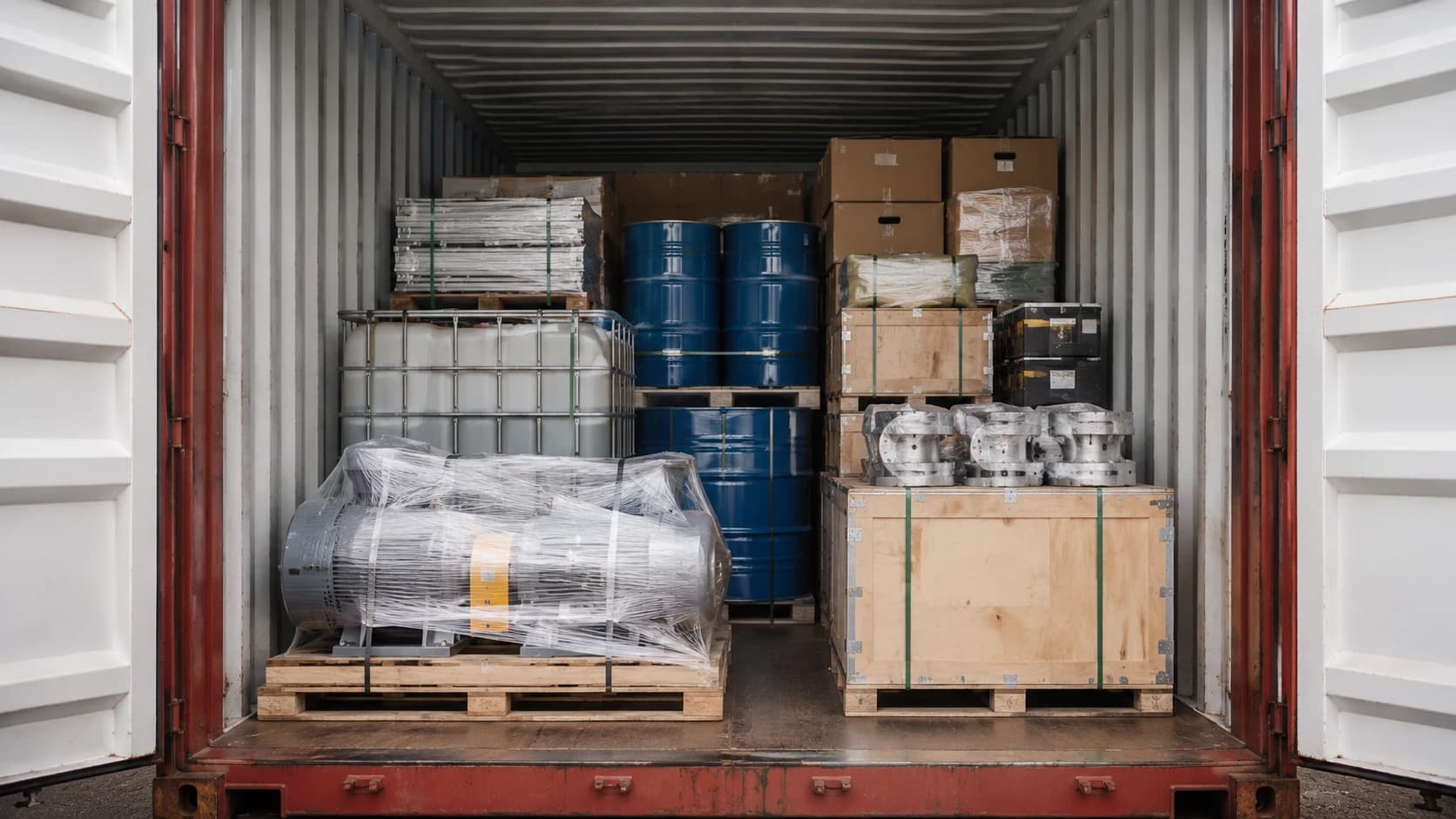
Choosing between LCL and FCL is the biggest cost decision you will make. A 20-foot container holds about 33 m³ (payload up to roughly 28 tonnes), a 40-foot about 58 m³, and a 40' High Cube about 65 m³. With LCL you share a container with other shippers and pay only for the space your goods occupy — ideal for a few cubic meters.
A useful rule of thumb: a dedicated container starts to pay off at around half a 20-footer, roughly 15 m³. A full household usually justifies FCL; boxes and a few pieces of furniture usually point to LCL. Send us your list of items and we will estimate the volume before anything gets packed.
3. The transfer-of-residence exemption — the big saver
If you are relocating to Poland permanently, your belongings can enter the country free of duty and VAT as mienie przesiedleńcze — transfer-of-residence goods. This is frequently the single largest saving in the entire move, provided the formal conditions are met and the paperwork is done right.
The key document is the household goods inventory (lista mienia przesiedlenia) — a free PDF form is available at lesniewski.com/formularze, and the online wizard at /formularze/wypelnij-online walks you through it step by step. Since 1994 we have guided thousands of families through this procedure.
- At least 12 months of residence outside the European Union
- Transfer of your center of life to Poland
- Goods must be your own property and in use — not for resale
- No selling the imported goods for 12 months after import
4. What the exemption does not cover
The exemption applies to personal belongings — it does not cover goods intended for resale or quantities that suggest a commercial purpose. Brand-new items bought right before departure, still in their boxes, can be challenged by customs, because the rules require the goods to be owned and used.
A car can be included in your transfer-of-residence goods, but it is governed by its own, more detailed conditions — worth discussing individually before you ship. For comparison, a vehicle imported outside the exemption carries 10% duty, 23% VAT, and excise tax of 3.1% (engine up to 2.0L) or 18.6% (above 2.0L).
A properly prepared inventory and complete documents are your best protection against surprises at clearance. We review the paperwork before loading so the exemption actually holds up.
5. How to lower your moving costs — legitimately
Volume is your biggest lever: with LCL, every cubic meter you don't ship is money saved — sometimes it makes sense to sell furniture in the US that would cost less to replace in Poland than to transport. Delivering your boxes to our New Jersey warehouse yourself removes the pickup charge entirely. Flexibility with dates helps too, since freight rates outside the peak season tend to be friendlier.
Packing your own boxes trims the service cost, and consolidating everything into one shipment is cheaper than sending things in batches. It also pays to estimate volume realistically before booking — paying for empty space in an oversized container is the most common unnecessary expense we see.
So what will your move cost? Send us your list of items and both addresses, and within 24 hours you will have a fixed, individual quote — no ranges, no hidden surcharges. Thanks to direct contracts with the carriers and no middlemen, we secure rates that are hard to get on your own.
Get a real price for your move
Send us your list of items and addresses, and the bilingual Leśniewski Shipping team will prepare a fixed quote within 24 hours. We have been moving household goods safely between the USA and Poland since 1994.
+1 (973) 372 1100Frequently asked questions
Will I pay duty and VAT on my belongings when moving to Poland?+
Not if you qualify for the transfer-of-residence exemption: at least 12 months of residence outside the EU, moving your center of life to Poland, goods that are your own and in use (not for resale), and no sale of the goods for 12 months after import. We help prepare the inventory and handle the formalities.
When is a full container cheaper than shared LCL freight?+
The practical threshold is around half a 20-foot container, roughly 15 m³. Below that, LCL usually wins because you pay only for the space you use; above it, a dedicated 20' (about 33 m³) or 40' (about 58 m³) container typically makes more sense.
How long does a move from the USA to Poland take?+
The ocean leg from New York/New Jersey to Gdynia takes about 16–20 days, and the full door-to-door move typically runs 4–6 weeks including pickup, consolidation, customs, and delivery. From Savannah the sailing takes about 18–24 days, from Houston 24–30, and from Los Angeles 30–38 days.
How quickly will I get a price for my move?+
We send a fixed, individual quote within 24 hours of receiving your inquiry. All we need is a rough list of your items plus the pickup address in the USA and the delivery address in Poland — we calculate the rest for you.