How to import a car from Copart or IAA — step by step
Importing a car from Copart or IAA takes seven steps: find a car and check its title type, read the listing (damage codes, mileage, Run & Drive status), bid through a licensed dealer, pay for the car and collect it from the yard within a few business days, truck it to the port in New Jersey or Savannah and ship it in a shared 40' container to Gdynia in Poland, clear customs, and finally have any US-to-EU conversions done and register the car. Getting from auction purchase to delivery at your door usually takes 6–10 weeks.
We are a family business that has shipped cargo from the USA to Poland since 1994 as an NVOCC licensed by the US Federal Maritime Commission (FMC). We can bid for you, or you can bid yourself on our platform lesniewskiauction.com, and we handle transport, customs clearance in Gdynia and US-to-EU conversions in our own workshop. The tax and registration details below are the rules in Poland. If your car is going to another European country, tell us when you ask for a quote, because taxes and registration differ by country and we check them case by case.
1. Find a car and check the title type
You can browse Copart and IAA auctions on lesniewskiauction.com. Every car has a lot number, which makes it easy to find and quote. Before you think about price, check which ownership document (title) the vehicle has, because it decides who is allowed to buy it.
According to Copart's help center, a salvage title is usually issued when an insurer has declared the car a total loss because repairs would cost more than the car is worth. A clean title goes with a car that runs or can be repaired and can be registered and insured in the US. A rebuilt title goes with a former salvage car that was repaired and went through the state's process. IAA adds that a car with a clear title has never been declared a total loss by an insurer. The criteria for issuing titles differ from state to state.
2. Read the listing: damage, mileage and Run & Drive
Copart shows two damage codes on each lot: Primary Damage and Secondary Damage. Its official glossary includes codes such as FR (front end), RR (rear end), SD (side), HL (hail), WA (water/flood), MN (minor dents/scratches) and FD (frame damage reported). Copart also states that the codes reflect only known or reported damage and should not be relied on when deciding to bid.
Copart describes mileage with one of four odometer codes: ACTUAL (the reading is believed to be the true mileage), NOT ACTUAL (the reading does not reflect the true mileage, or the mileage cannot be known), EXCEEDS MECHANICAL LIMITS (the mileage has gone past what the odometer can show, for example it passed its maximum and started again at 0) and EXEMPT (federal law does not require an odometer reading to be shown for this vehicle).
Run & Drive does not mean road-ready. Copart uses it when, at check-in, the car started (on its own or with an external jump box), could be put into gear and moved forward. IAA sets three conditions: the engine starts and idles (with or without a jump); forward and reverse gears engage; and the steering wheel turns one full rotation each way. Both auctions say plainly that this is no guarantee of roadworthiness, and both sell vehicles “as is, where is” with no warranty.
That is why, before you set a price cap, we help you assess the photos, the extent of the damage and the vehicle history (Carfax/AutoCheck). In the listing, check these first:
- Title type: clean, salvage, rebuilt or another document
- Primary and Secondary Damage codes plus every photo
- Odometer description: ACTUAL, NOT ACTUAL, EXCEEDS MECHANICAL LIMITS or EXEMPT
- Keys field: whether the auction has the keys (Copart does not guarantee them)
- Run & Drive or Engine Start Program (the latter means the engine started and ran at idle at check-in)
3. Bid through a licensed dealer
Copart explains that every state has its own rules on buying vehicles at auction, and which vehicles you can buy depends on the laws where the vehicle is located. Copart also notes that most states require a license to purchase vehicles of each title type. The simplest route is to buy through a company with a dealer license: we bid on your behalf up to the cap you set, and you don't need your own auction account.
Two rules from Copart's terms are worth knowing before your first bid. A submitted bid cannot be retracted. And if the seller listed the car with a minimum bid or as “On Approval,” the seller has until 7:45 p.m. Pacific Time on the next business day to accept the high bid. So winning the bidding does not always mean the car is yours right away.
4. Pay and collect the car from the yard on time
After a win, business days count. IAA's auction rules require payment within three business days (auction day plus two business days), and paying late triggers a late fee. Copart moves cars not removed by 5:00 p.m. local time on the third business day after the sale to a locked storage area and releases them only after an additional gate and storage fee, where applicable, is paid. At IAA the branch sets the pickup window, and storage is charged for every day after it.
So we agree payment terms with you before bidding, and after a win we book the truck. Under Copart's terms, the risk of loss or damage passes to the auction buyer as soon as the bid is accepted, so a quick pickup also protects the car. We also obtain the title from the auction and handle it through export and customs.
5. Truck to the port and a shared 40' container
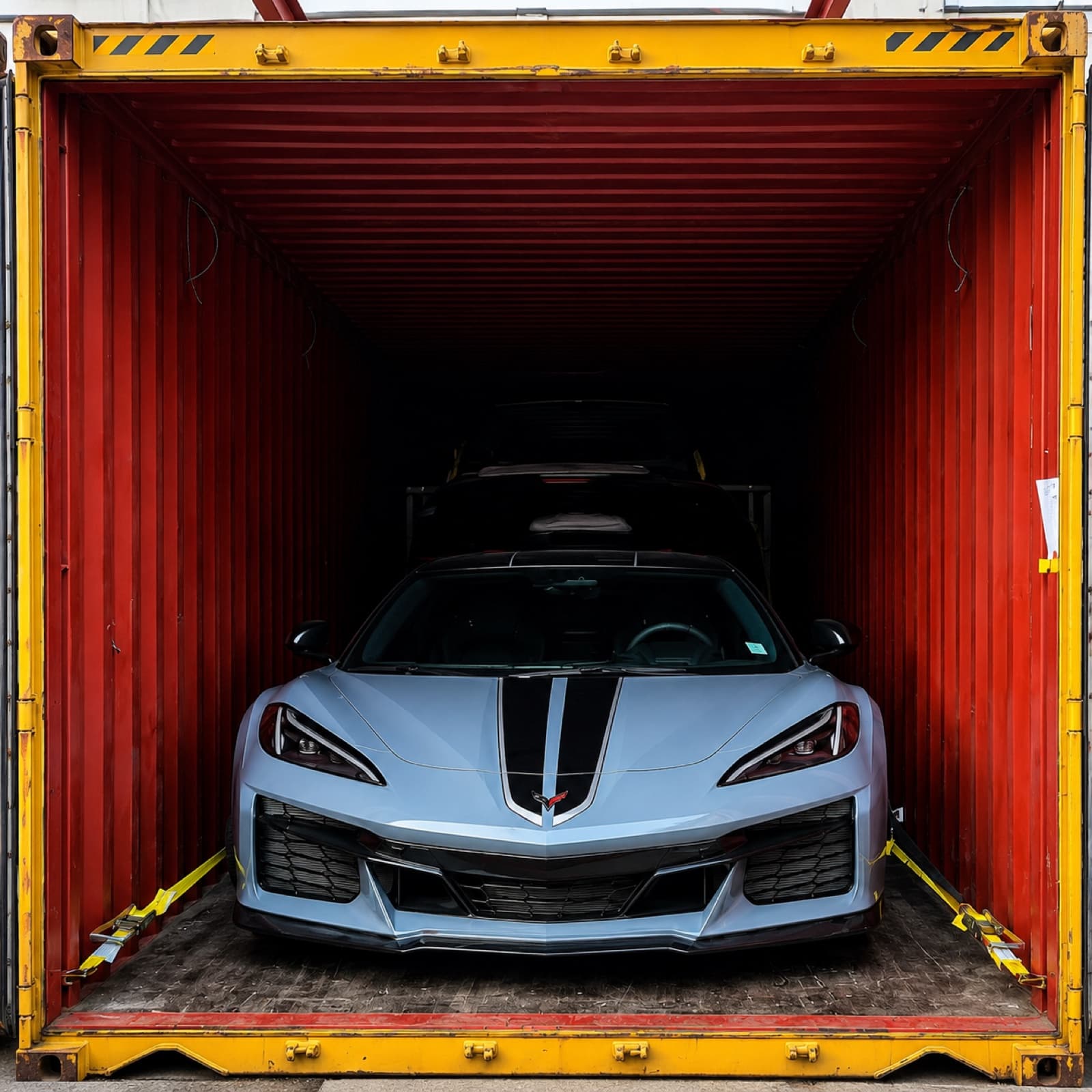
From the auction yard the car goes by truck to New Jersey or Savannah. From there we ship cars to Gdynia consolidated in 40' containers with other vehicles. US Customs and Border Protection (CBP) requires the vehicle and its documents, including the original title or a certified copy, to be presented at the port at least 72 hours before export. We take care of that.
The ocean leg from New Jersey to Gdynia typically takes 16–20 days, and from Savannah 18–24 days. If you are moving to Poland with your household goods, the car can travel in the same container as your belongings, even together with a motorcycle. There is one condition: the car must be empty. Sailing times, documents and costs for Poland are covered on our car shipping from the USA to Poland page.
6. Customs clearance in Gdynia: duty, excise and VAT
We handle customs clearance in Gdynia for you. It all starts with the customs value: under the Union Customs Code (UCC), it includes the price of the car plus transport and insurance costs up to the point where the car enters the EU customs territory.
The EU import duty on a passenger car (CN 8703) is 10% of its customs value.
In Poland, excise tax is added: 3.1% for engines up to 2,000 cm³ and 18.6% above 2,000 cm³. Hybrids have lower rates: 1.55% for a hybrid other than a plug-in with an engine up to 2,000 cm³, and 9.3% for a hybrid, including a plug-in, with an engine over 2,000 cm³ but not more than 3,500 cm³. Electric cars are exempt from excise, and plug-in hybrids with an engine up to 2,000 cm³ are exempt until December 31, 2029. Polish excise is calculated on the customs value plus duty, and 23% VAT on the customs value plus duty and excise. Both bases also include any commission, transport and insurance costs up to the first place of destination in Poland that are not already in the customs value. An illustrative example in Poland for a hypothetical customs value of PLN 40,000, a non-hybrid combustion engine up to 2,000 cm³ and no extra costs to add (amounts not rounded):
- Duty 10%: PLN 4,000
- Excise 3.1% of PLN 44,000: PLN 1,364
- VAT 23% of PLN 45,364: PLN 10,433.72
- Duty, excise and VAT combined: PLN 15,797.72
7. US-to-EU conversions and registration in Poland
We can prepare the cars we import in our own workshop in Krze Duże near Radziejowice, Poland. We carry out US-to-EU conversions there, such as lighting. The scope depends on the model, and we agree it case by case. New parts for repairs can be bought from US stores and eBay through our sister site lesniewskiczesci.com.
In Poland you register the car at the vehicle registration office for your place of residence. For a car from outside the EU, the application must be filed within 30 days of its release for free circulation by the customs and tax office, and third-party liability insurance (OC) must be bought first. The office registers the car temporarily for 30 days and issues a temporary permit and plates. The official gov.pl service lists documents including the ones below, and the office may ask for others depending on the case:
- Registration application
- Proof of ownership, such as a purchase agreement or invoice
- Certificate of a positive technical inspection
- Import customs clearance document
- Previous plates, or a statement that the car has none
- Proof that all fees have been paid
- Translations of foreign-language documents by a sworn translator or a Polish consul
Found a lot on Copart or IAA?
Send us the lot number or auction link. We'll check the title, damage and history, and you'll get a free import quote within 24 hours.
+1 (973) 372 1100Frequently asked questions
What is the difference between a clean title and a salvage title?+
A salvage title is usually issued when an insurer declares a car a total loss because repairs would exceed its value. A clean title goes with a car that runs or can be repaired and can be registered and insured in the US. A rebuilt title goes with a former salvage car that was repaired and went through the state's process. We check the title before bidding, because it affects who can buy the car.
What does Run & Drive mean at Copart and IAA?+
At Copart, it means that at check-in the car started, could be put into gear and moved forward. At IAA, the engine started and idled, forward and reverse gears engaged, and the steering wheel made one full turn in each direction. Both auctions state that it is not a guarantee that the car is roadworthy.
How long do I have to pay for and collect a car after winning?+
Not long. IAA requires payment within three business days (auction day plus two business days). Copart moves cars not removed by 5:00 p.m. local time on the third business day after the sale to locked storage and releases them only after an additional gate and storage fee, where applicable, is paid. That is why we agree payment terms before bidding and book a truck once you win.
Does a US car need modifications before registration in Poland?+
Registration in Poland requires a certificate of a positive technical inspection. In our workshop in Krze Duże we carry out US-to-EU conversions, such as lighting, for the cars we import. Whether any changes are needed, and which ones, depends on the model, so we check it case by case.
Which documents does the registration office need for a car bought at Copart or IAA?+
The official gov.pl service lists, among others, the registration application, proof of ownership (such as a purchase agreement or invoice), a certificate of a positive technical inspection, the import customs clearance document, previous plates or a statement that the car has none, proof that all fees have been paid, and translations of foreign-language documents by a sworn translator or a Polish consul. Buy third-party liability insurance (OC) first, and file the application within 30 days of the car's release for free circulation by the customs and tax office. The office may ask for other documents depending on the case.